Call or Text 727-513-9780
  • Shopping Cart Shopping Cart
    0Shopping Cart
Pure Tested Peptides | America's most trusted Peptides for sale online
  • Peptides for sale
    • Oral Peptides for sale
      • Peptide Capsules for sale
      • BPC 157 Capsules 1000mcg
      • SLU-PP-332 Capsules | 1000 mcg
      • 5-Amino-1MQ 50mg Capsules
      • Tesofensine 500mcg
    • All Peptides for sale
    • Peptide Sprays
      • BPC 157 Nasal Spray Kit
      • BPC-157 TB500 Nasal Spray Kit
      • Semax Nasal Spray 10mg
      • Selank – Nasal Spray Kit – 10mg
      • Epithalon 50MG Nasal Spray Kit
      • Ipamorelin 10mg Nasal Spray
      • Klow Nasal Spray (BPC-157 + TB-500 + GHK-Cu + KPV) | 80mg
      • Hulk Nasal Spray Tesa / Ipa Blend 6/3 MG
      • Klow Nasal Spray
      • NAD + 500 mg Nasal Spray
      • PT-141 Nasal Spray Kit
    • GHRH Peptides
      • Ipa Peptides
      • CJC-1295 Peptides
        • CJC-1295 with DAC 5 mg
        • CJC-1295 without DAC 5 mg
        • CJC-1295 Ipa 10mg
      • Tesa Peptides
        • Tesa Peptide
        • Tesa 20 mg
    • GHK-Cu Peptides
      • All GHK-Cu Peptides
      • GHK-Cu 100mg
      • KLOW Peptide Blend – Buy KLOW blend online
    • BPC Peptides
      • All BPC Peptides
      • BPC-157
      • BPC-157 TB-500
      • BPC 157 capsules 1000mcg
    • SLU-PP-332 Peptides
      • All SLU-PP-332 Peptides
      • SLU-PP-332 5mg
    • GLP3 Peptides
      • GLP3-R
      • GLP3-R CAG 10mg
      • GLP3-R 20mg
    • PT-141 Peptides
      • PT-141 Peptides for sale
      • PT-141 10mg
      • PT-141 Nasal Spray
    • CAG Peptides
      • Lipo-C Peptide Blend
      • CAG 5mg
      • CAG 10mg
    • MOTS-C Peptides
      • MOTS-C Peptides for sale
      • MOTS-c peptide
      • MOTS-c 10mg *6 pack*
    • 5 Amino 1MQ Peptides
      • 5 Amino 1MQ Peptides for sale
      • 5-Amino-1MQ 50mg Capsules
      • 5-Amino-1MQ 5mg
    • Epithalon Peptides
      • Epithalon Peptides for sale
      • Epithalon 10mg
      • Epithalon 50mg
  • Shop
    • GLPs
      • 5-Amino-1MQ 50mg Capsules
      • 5-Amino-1MQ 5mg
      • GLP3-Reta
      • L-Carnitine 500mg/ml
      • Tesofensine 500mcg
      • SLU-PP-332 5mg
      • MOTS-c 10mg *6 pack*
    • Epithalon & BPC Peptides
      • Epithalon 10mg
      • Epithalon 50mg
      • BPC-157
      • BPC 157 capsules 1000mcg
      • BPC-157 TB-500
      • BPC-157 TB500 Nasal Spray Kit
      • BPC 157 Nasal Spray Kit
    • BPC TB-500 & NAD+ Peptides
      • NAD+ 500 mg
      • KLOW Peptide Blend – Buy KLOW blend online
      • GLOW Peptide Blend
      • TB 500 5mg
      • BPC 157 capsules 1000mcg – Supplement
      • BPC 157 Nasal Spray Kit
      • BPC-157
      • BPC-157 TB500 Nasal Spray Kit
      • BPC-157 TB-500
      • BPC 157 capsules 1000mcg
    • LL-37 Peptide
      • LL-37 10 mg
    • MOTS-C & Selank
      • MOTS-c peptide
      • Selank 10mg
    • GHK Peptides
      • GHK-Cu 100mg
      • GLOW Peptide Blend
      • KLOW Peptide Blend – Buy KLOW blend online
  • COAs
  • Wholesale
    • Wholesale Peptides for sale
  • PTP FAQ
  • Affiliates
    • Selank Peptide: Advanced Pharmacological Mechanisms Underlying Its Anxiolytic and Nootropic Effects in Research
      • 5-Amino-1MQ Peptide: Detailed Mechanisms of NNMT Inhibition and Its Impact on Cellular Metabolism Research
        • MOTS-C Peptide: Unraveling Its Role in Mitochondrial Dynamics and Energy Metabolism Research
          • Epithalon Peptide and Telomerase Regulation: Investigating Its Impact on Cellular Senescence and Lifespan Research Models
            • GLP2-T vs GLP2 Tirz Peptide: Understanding the Naming, Mechanistic Nuances, and Research Implications for Gut Health
      • Peptides and Polypeptides in Modern Pharmacology: What Research on Metoprolol, Prednisone, and Amlodipine Reveals
        • Polypeptide Peptides vs NSAIDs: What Naproxen and Diclofenac Teach Tissue-Repair Researchers About BPC‑157 and TB‑500
          • Peptides and Polypeptides in Endocrine Pharmacology: How GLP-1, GLP-2, and GLP-3 Retatrutide Differ From Classic Drugs Like Prednisone and Amlodipine
          • 5‑Amino‑1MQ Peptide and NNMT Inhibition: How It Compares With Statins Like Atorvastatin in Adipose and Lipid Metabolism Research
      • Enclomiphene, Estrogen Receptor Signaling, and Luteinizing Phase Biology: What Hormone Researchers Should Measure
        • Mesenchymal Stem Cells, BPC‑157, and GHK‑Cu: How Tissue Repair Peptides Compare With Classic NSAIDs Like Naproxen in Injury Models
          • Peptide Calculator Use Cases Beyond Growth Hormone: Working Through GLP‑3 Retatrutide, MOTS‑c, and BPC‑157 Research Dosing
        • Polypeptide Peptides in Endocrine and Metabolic Pharmacology: Lessons From Amlodipine, Prednisone, and Metoprolol
        • Peptides Calculator for Advanced Blends: Worked Examples for Tesamorelin, CJC‑1295, and Ipamorelin Stacks
          • Peptides and Polypeptides in Human Physiology: How Molecular Size Shapes Research Applications
            • Selank Peptide: Advanced Pharmacological Mechanisms Underlying Its Anxiolytic and Nootropic Effects in Research
          • 5-Amino-1MQ Peptide: Detailed Mechanisms of NNMT Inhibition and Its Impact on Cellular Metabolism Research
            • MOTS-C Peptide: Unraveling Its Role in Mitochondrial Dynamics and Energy Metabolism Research
              • Epithalon Peptide and Telomerase Regulation: Investigating Its Impact on Cellular Senescence and Lifespan Research Models
                • GLP2-T vs GLP2 Tirz Peptide: Understanding the Naming, Mechanistic Nuances, and Research Implications for Gut Health
                  • Peptides and Polypeptides in Endocrine Pharmacology: How GLP-1, GLP-2, and GLP-3 Retatrutide Differ From Classic Drugs Like Prednisone and Amlodipine
                    • Polypeptide Peptides vs NSAIDs: What Naproxen and Diclofenac Teach Tissue-Repair Researchers About BPC‑157 and TB‑500
                      • Peptides and Polypeptides in Modern Pharmacology: What Research on Metoprolol, Prednisone, and Amlodipine Reveals
                        • 5‑Amino‑1MQ Peptide and NNMT Inhibition: How It Compares With Statins Like Atorvastatin in Adipose and Lipid Metabolism Research
                        • Enclomiphene, Estrogen Receptor Signaling, and Luteinizing Phase Biology: What Hormone Researchers Should Measure
                        • Mesenchymal Stem Cells, BPC‑157, and GHK‑Cu: How Tissue Repair Peptides Compare With Classic NSAIDs Like Naproxen in Injury Models
                        • Peptide Calculator Use Cases Beyond Growth Hormone: Working Through GLP‑3 Retatrutide, MOTS‑c, and BPC‑157 Research Dosing
                        • Polypeptide Peptides in Endocrine and Metabolic Pharmacology: Lessons From Amlodipine, Prednisone, and Metoprolol
                        • Peptides Calculator for Advanced Blends: Worked Examples for Tesamorelin, CJC‑1295, and Ipamorelin Stacks
                        • Peptides and Polypeptides in Human Physiology: How Molecular Size Shapes Research Applications
                        • Selank Peptide: Advanced Pharmacological Mechanisms Underlying Its Anxiolytic and Nootropic Effects in Research
                        • MOTS-C Peptide: Unraveling Its Role in Mitochondrial Dynamics and Energy Metabolism Research
                        • Peptides and Polypeptides in Modern Pharmacology: What Research on Metoprolol, Prednisone, and Amlodipine Reveals
                        • Peptides and Polypeptides in Endocrine Pharmacology: How GLP-1, GLP-2, and GLP-3 Retatrutide Differ From Classic Drugs Like Prednisone and Amlodipine
                        • 5-Amino-1MQ Peptide: Detailed Mechanisms of NNMT Inhibition and Its Impact on Cellular Metabolism Research
                        • Mesenchymal Stem Cells, BPC‑157, and GHK‑Cu: How Tissue Repair Peptides Compare With Classic NSAIDs Like Naproxen in Injury Models
                        • Peptide Calculator Use Cases Beyond Growth Hormone: Working Through GLP‑3 Retatrutide, MOTS‑c, and BPC‑157 Research Dosing
                        • GLP2-T vs GLP2 Tirz Peptide: Understanding the Naming, Mechanistic Nuances, and Research Implications for Gut Health
                        • Polypeptide Peptides in Endocrine and Metabolic Pharmacology: Lessons From Amlodipine, Prednisone, and Metoprolol
                        • Polypeptide Peptides vs NSAIDs: What Naproxen and Diclofenac Teach Tissue-Repair Researchers About BPC‑157 and TB‑500
                        • Peptides and Polypeptides in Human Physiology: How Molecular Size Shapes Research Applications
                        • Peptides Calculator for Advanced Blends: Worked Examples for Tesamorelin, CJC‑1295, and Ipamorelin Stacks
                        • 5‑Amino‑1MQ Peptide and NNMT Inhibition: How It Compares With Statins Like Atorvastatin in Adipose and Lipid Metabolism Research
                        • Enclomiphene, Estrogen Receptor Signaling, and Luteinizing Phase Biology: What Hormone Researchers Should Measure
                        • Epithalon Peptide and Telomerase Regulation: Investigating Its Impact on Cellular Senescence and Lifespan Research Models
                        • Best research protocol Klow blend
                        • best time to take BPC-157
                        • best time to take DSIP (Delta Sleep Inducing Peptide)
                        • best time to take CJC-1295
                        • best time to take AOD-9604
                        • best time to take Follistatin 344
                        • best time to take Ipamorelin
                        • best time to take MK-677 (Ibutamoren)
                        • best time to take Ligandrol (LGD-4033) — research compound
                        • best time to take Ostarine (MK-2866) — research compound
                        • best time to take GHK-CU
                        • best time to take TB-500
                        • best time to take MOTS-c
                        • best time to take Semax
                        • best time to take RAD-140 (Testolone) — research compound
                        • best time to take Thymosin Alpha-1
                        • best time to take PEG-MGF
                        • Biolife Plasma, Octapharma Plasma, and Research Peptides: How Plasma Donation Labs Differ From Peptide Suppliers
                        • best time to take YK-11 — research compound
                        • best time to take PT-141 (Bremelanotide)
                        • Best research protocol Klow blend
                        • 5-Amino-1MQ and MOTS-C Synergy: Metabolic Signaling, Mitochondria, and Research Design
                        • BPC-157 and TB-500: Investigating Their Combined Effects on Angiogenesis and Cellular Migration in Tissue Repair Models
                        • BPC-157 Peptide: Gut Barrier Function, Inflammation, and Tissue-Recovery Research
                        • 5‑Amino‑1MQ and MOTS‑c Synergy in Metabolic Research: Designing NNMT and Mitochondrial Biogenesis Stacks
                        • CJC-1295 with DAC vs. Without DAC: Half-Life, Release Kinetics, and Research Implications
                        • CJC‑1295 with DAC vs. Without DAC: Expanding on Half‑Life Differences Using Tesamorelin and Ipamorelin Blend Case Studies
                        • Collagen Biology and Copper‑Binding Peptides: How GHK‑Cu, Glow Blend, and Klow Blend Interact with Skin and Connective Tissue
                        • Collagen Biology and Regenerative Peptides: How GHK‑Cu, Glow Blend, and Klow Blend Affect Extracellular Matrix Research
                    • DNA, Telomeres, and Longevity Peptides: Positioning Epithalon and MOTS‑c in Genetic Aging Research
                      • Enclomiphene Citrate: serm Mechanism, Testosterone Research, and Stack Compatibility
                        • Enclomiphene vs Enclomiphene Citrate: Formulation, Bioavailability, and Research Distinctions
                        • Epithalon Peptide Research: Telomerase Activation, Aging, and Pineal Gland Function
                        • Estrogen Receptor Signaling and Enclomiphene: How Selective Modulators Compare with Classic Polypeptide Hormones
                        • GHK-Cu Peptide: Advanced Mechanisms in Extracellular Matrix Remodeling and Wound Healing Research
                        • GHK-Cu Peptide: Collagen Synthesis, Wound Repair, and Skin-Barrier Research Models
                        • GLP-1 vs GLP-3 vs GLP-2: Peptide Classification and Research Applications
                        • GLP-2 Peptide Research Guide: Gut Barrier Function, Nutrient Absorption, and Intestinal Recovery Models
                        • GLP-3 Retatrutide vs. GLP-1 Drugs: What Triple-Agonist Biology Changes in Research Models
                        • Ipamorelin and Tesamorelin Combination: Synergistic GH Secretagogue Research and Dosing Protocols
                        • GLP2 Tirz Peptide: What It Is, Why the Name Exists, and How Researchers Should Interpret It
                        • Klow Blend Peptide Nasal Spray: What the Formulation Is Trying to Do in Cognitive Research
                        • Mitochondria, NNMT Inhibition, and Peptide Modulators: Where MOTS‑c and 5‑Amino‑1MQ Fit in Cellular Energy Research
                        • MOTS-c Peptide: Mitochondrial Function, Energy Metabolism, and What Researchers Measure
                        • MOTS-c vs. 5-Amino-1MQ: Which Metabolic Research Questions Each Compound Actually Answers
                        • Nasal Spray Peptides: Bioavailability, Administration, and Semax/Selank Research Applications
                        • PT-141 Peptide Research: Mechanism of Action and Melanocortin Receptor Signaling
                        • Retatrutide for Research: Mechanism, Structure, and GLP-1/GLP-3 Dual Action
                        • Retatrutide for Obesity and Type 2 Diabetes: What the Latest Trial Data Suggest
                        • Tesofensine Peptide Research: Mechanism, Appetite Suppression, and Neuropeptide Y Pathways
  • Contact
    • Contact Customer Service
    • Text Customer Support
  • About US
  • Shop all peptides
  • Affiliate Program
    • Affiliate Signup
  • Login / Register Login / Register Page Link Login / Register Page Link
  • Click to open the search input field Click to open the search input field Search
  • Menu Menu
Best Nasal Spray Peptides for Cognitive and Appetite Research: Semax, Selank, Klow Spray, and Tesofensine Compared

Best Nasal Spray Peptides for Cognitive and Appetite Research: Semax, Selank, Klow Spray, and Tesofensine Compared

September 2, 2026/0 Comments/in Uncategorized/by

Fewer than one in ten research compounds reach clinical advisory review at the FDA level, yet as of 2026, Semax is formally scheduled before the US Pharmacy Compounding Advisory Committee, a milestone that sets it apart from most peptides still confined to unregulated research markets. For labs evaluating intranasal peptide options, this regulatory asymmetry matters as much as formulation chemistry. This guide to the best nasal spray peptides for cognitive and appetite research: Semax, Selank, Klow Spray, and Tesofensine compared covers formulation details, excipients, dosing schemes, and bioavailability considerations that directly affect ordering decisions.

Key Takeaways

  • Semax and Selank are the dominant intranasal cognitive peptides in 2026, often combined in a single spray for complementary nootropic and anxiolytic effects.
  • Klow Spray is a branded intranasal blend designed for appetite and metabolic research, while Tesofensine is a monoamine reuptake inhibitor studied primarily for appetite suppression.
  • Intranasal delivery bypasses first-pass metabolism and may allow direct olfactory-to-brain transport, making excipient choice and actuation volume critical quality variables.
  • Combined Semax/Selank sprays typically offer lower cost per milligram than separate formulations, a practical factor for multi-week research protocols.
  • Regulatory status differs significantly across these four compounds, which affects sourcing, labeling, and permissible research contexts.

Formulation and Excipient Profiles Across the Four Compounds
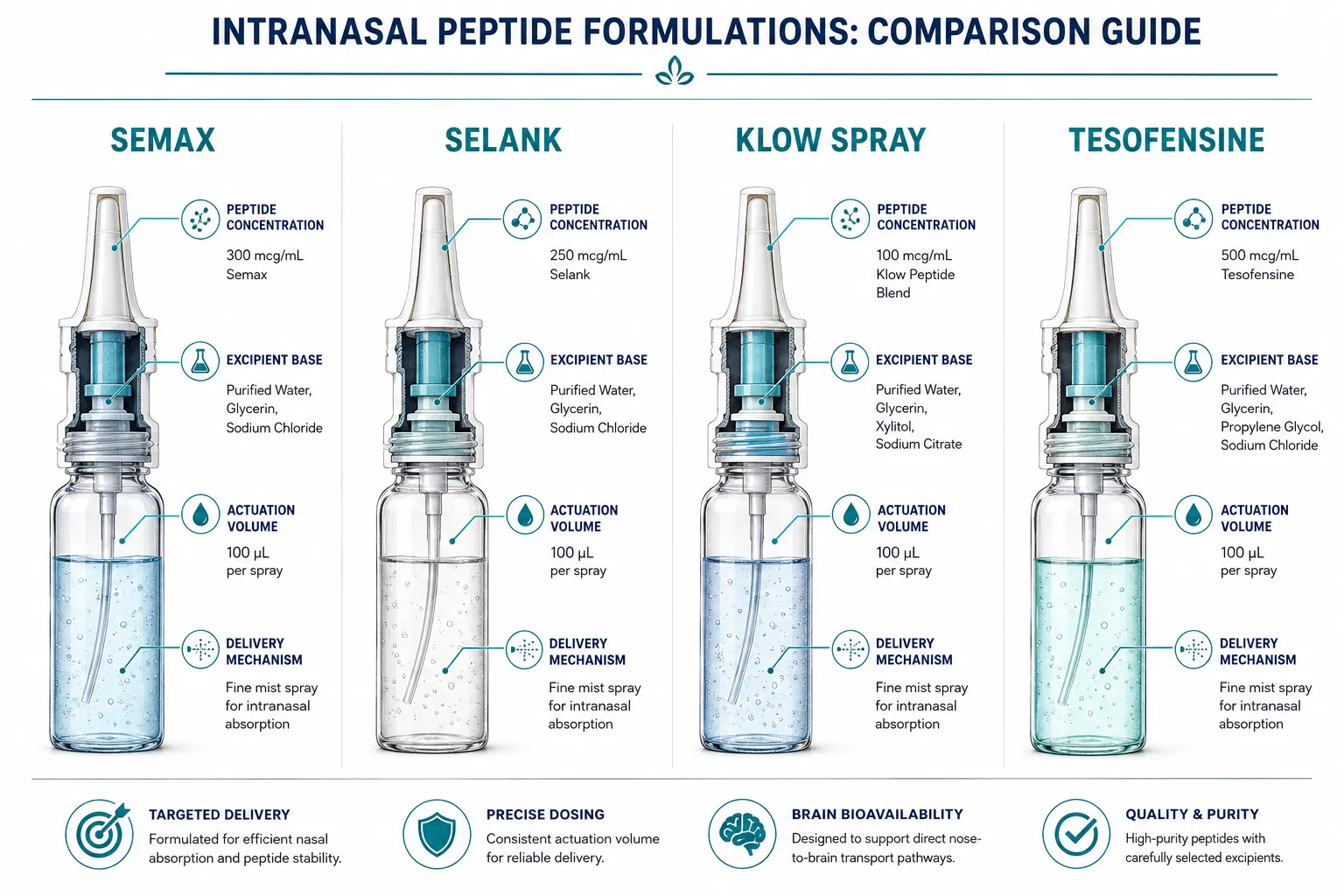
Formulation and Excipient Profiles Across the Four Compounds

Understanding what surrounds the active peptide is as important as the peptide itself. Excipients affect stability, mucosal absorption, and shelf life, all critical for reproducible research outcomes.

Semax is an ACTH analog heptapeptide typically supplied as an aqueous nasal spray. Standard research formulations use sterile water or saline as the carrier, sometimes with a small amount of preservative such as benzalkonium chloride. Concentrations in research-grade products commonly range from 0.1% (1 mg/mL) to 1% (10 mg/mL). The Semax ACTH analog classification is relevant here because its short peptide chain confers reasonable aqueous stability without requiring lyophilization in most commercial formats.

Selank shares a similar aqueous delivery format. As an intranasal anxiolytic peptide, it is frequently co-formulated with Semax in dual-peptide blends. Research suppliers offer combined sprays at concentrations such as 2.5 mg/mL of each peptide, delivering approximately 250 mcg per actuation. Larger blends of 20 mg Semax plus 20 mg Selank per bottle are marketed for cognition and neuroprotection research. For labs comparing these two compounds, the Selank vs Semax profile is a useful starting reference. The Selank intranasal delivery format is well-documented in research contexts, and its aqueous stability is comparable to Semax.

Klow Spray is a branded intranasal formulation targeting appetite and metabolic pathways. While exact proprietary excipient data varies by supplier, Klow-type sprays typically use a buffered saline base with absorption enhancers designed to improve mucosal uptake of larger or more hydrophilic peptide structures. Labs should request a certificate of analysis confirming pH range (ideally 4.5-6.5 for nasal tolerability) and osmolality.

Tesofensine differs structurally from the peptide trio above. It is a small-molecule monoamine reuptake inhibitor, not a peptide, that inhibits reuptake of serotonin, dopamine, and norepinephrine. Intranasal tesofensine formulations are less standardized than oral capsule formats. Excipient considerations include solubility enhancers and viscosity agents to ensure consistent actuation. Its non-peptide nature means it does not face the same stability challenges as Semax or Selank, but it requires careful pH management to prevent mucosal irritation.

Dosing Schemes and Bioavailability Considerations
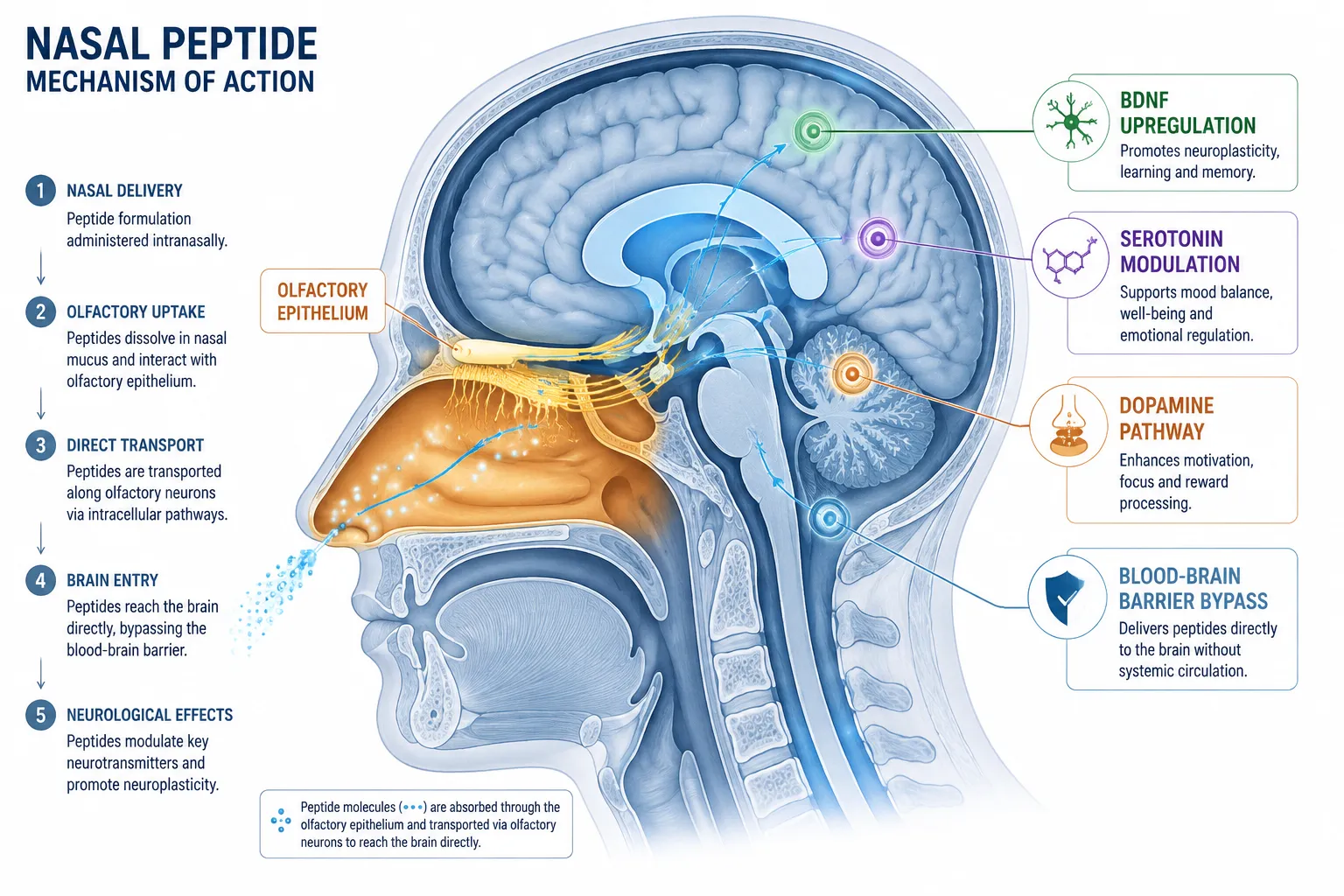
Dosing Schemes and Bioavailability Considerations

Bioavailability through the nasal mucosa is generally estimated at 10-30% for peptides, depending on molecular weight, lipophilicity, and formulation. The olfactory epithelium pathway offers a potential direct route to the central nervous system, bypassing the blood-brain barrier, a key reason intranasal delivery is preferred for cognitive peptides over subcutaneous injection in many research protocols.

Semax dosing in current 2026 research guides typically falls between 200 and 600 mcg intranasally, administered one to three times daily. A Semax BDNF upregulation mechanism is frequently cited as the basis for its cognitive-enhancement profile, with BDNF supporting neuroplasticity and memory consolidation.

Selank dosing is generally slightly lower, at 200-400 mcg per session. A well-documented 2026 stack protocol pairs 300 mcg Semax in the morning with 250 mcg Selank in the morning or early afternoon, cycled five days on and two days off. This cycling approach treats both peptides as short-course nootropics rather than continuous therapies. The Selank peptide research profile consistently highlights its anxiolytic and mood-stabilizing properties without sedation, a meaningful distinction from benzodiazepine-class compounds. Labs interested in that comparison can review the Selank vs benzodiazepine literature.

Klow Spray dosing protocols vary by supplier and target pathway. Research designs typically use one to two actuations per session, with sessions spaced to avoid receptor desensitization. Bioavailability data for Klow-type formulations is limited compared to the Semax/Selank literature, which is a consideration for labs designing quantitative outcome studies.

Tesofensine intranasal research doses are generally lower than oral equivalents due to the avoidance of first-pass metabolism. Oral clinical trials used 0.25-1 mg daily; intranasal equivalents require careful titration. The triple monoamine mechanism makes tesofensine relevant to triple agonist peptides research frameworks, even though tesofensine itself is not a peptide.

Key formulation note: For all four compounds, actuation volume consistency, typically 50-100 mcL per spray, directly determines dose reproducibility. Labs should verify actuation volume and pump mechanism before committing to a supplier.

Comparing Research Applications: Cognitive vs. Appetite Targets
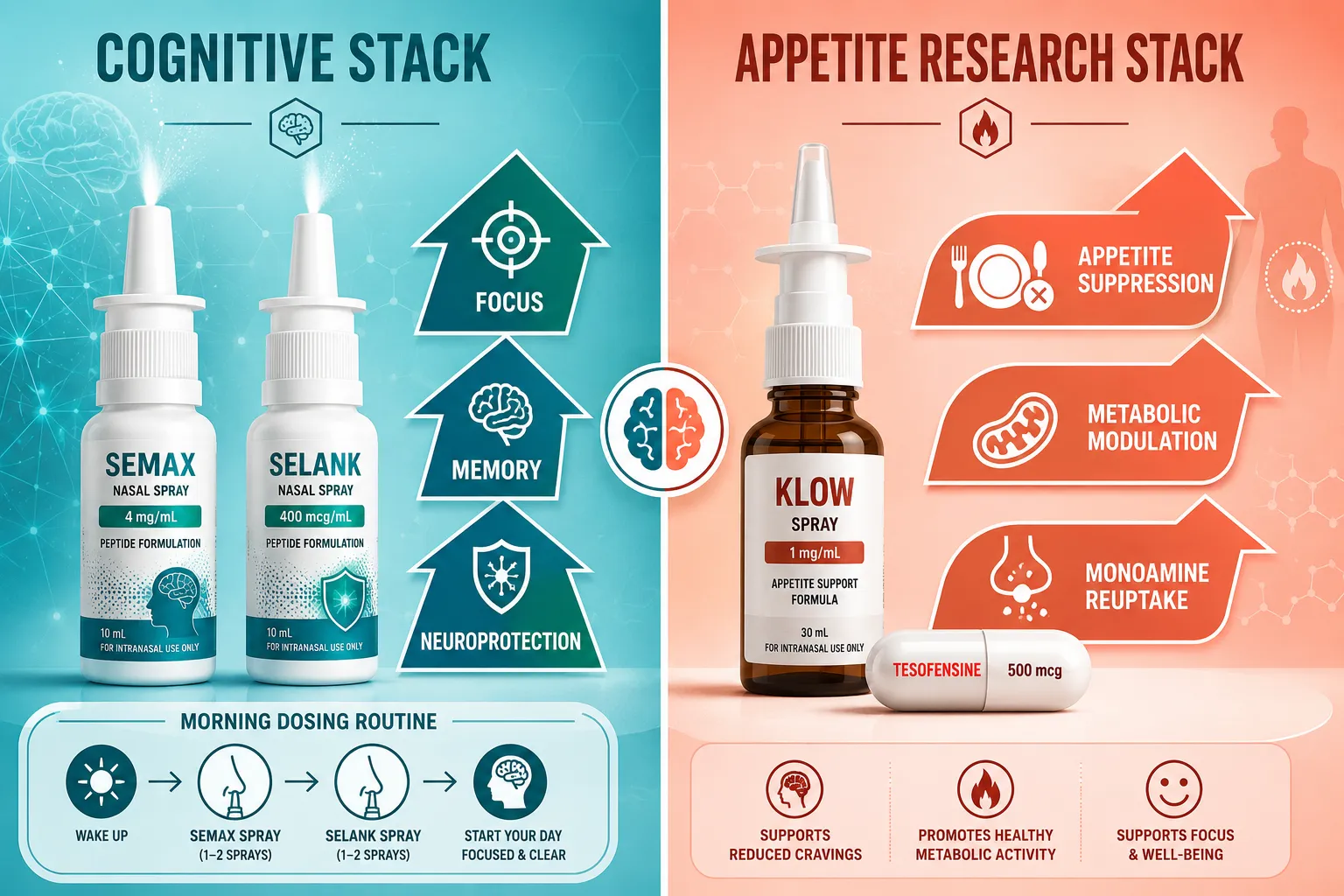
Comparing Research Applications: Cognitive vs. Appetite Targets

The four compounds divide naturally into two research categories, though overlap exists.

Compound Primary Research Target Delivery Format Regulatory Note (2026)
Semax Cognition, neuroprotection, BDNF Aqueous nasal spray PCAC review scheduled July 2026
Selank Anxiety reduction, calm focus Aqueous nasal spray Research use only; no US docket
Klow Spray Appetite, metabolic modulation Buffered intranasal blend Research use only
Tesofensine Appetite suppression, monoamine reuptake Small-molecule spray or oral Research use only

For labs focused on cognitive outcomes, the Semax/Selank combination remains the most evidence-supported intranasal option in 2026. The "focus and drive" profile of Semax complements the "calm and steady" anxiolytic character of Selank, and combined sprays reduce both cost and protocol complexity. Separate 30 mg sprays of each typically cost more per milligram than combined 1:1 blends, making dual-peptide formulations a practical choice for multi-week studies.

For appetite and metabolic research, Klow Spray and tesofensine address different mechanistic targets. Klow Spray operates through peptide-based pathways relevant to satiety signaling, while tesofensine's monoamine reuptake inhibition affects appetite through central dopaminergic and serotonergic circuits. Labs should not treat these as interchangeable; study design should reflect the distinct mechanisms. Broader systemic peptide research frameworks can help contextualize how these compounds interact with whole-body metabolic signaling.

Conclusion

For labs evaluating the best nasal spray peptides for cognitive and appetite research, Semax, Selank, Klow Spray, and Tesofensine compared, the ordering decision comes down to three practical priorities: research target alignment, formulation quality, and regulatory awareness.

Actionable next steps for research teams:

  • Verify excipient data before ordering any intranasal peptide. Request certificates of analysis confirming pH, osmolality, preservative type, and actuation volume.
  • Match the compound to the research question. Use Semax and Selank for cognitive and neuroprotective endpoints; use Klow Spray or tesofensine for appetite and metabolic studies.
  • Apply cycling protocols for Semax and Selank (five days on, two days off) to maintain receptor sensitivity across multi-week study designs.
  • Monitor Semax regulatory developments closely. Its July 2026 PCAC review could affect compounding availability and labeling requirements within the US market.
  • Source from suppliers with transparent labeling. Products explicitly marked "for research use only" with full compositional disclosure are the appropriate standard for laboratory procurement.

Selecting the right intranasal peptide formulation is not just a chemistry decision, it is a study design decision. Matching mechanism to endpoint, and formulation to protocol, is what separates reproducible research from inconclusive data.

Tags: appetite research peptides, cognitive peptides, intranasal peptide delivery, klow spray, nasal spray peptides, selank peptide, semax research, tesofensine
https://www.puretestedpeptides.com/wp-content/uploads/2026/09/best-nasal-spray-peptides-for-cognitive-and-appetite-research-semax-selank-klow.webp 1024 1536 https://www.puretestedpeptides.com/wp-content/uploads/2026/01/buy-peptides-online.jpg 2026-09-02 13:04:472026-09-02 13:04:47Best Nasal Spray Peptides for Cognitive and Appetite Research: Semax, Selank, Klow Spray, and Tesofensine Compared
You might also like
Tesofensine and Metabolic Research: How a Noradrenergic Appetite Modulator Compares With GLP‑3 Peptides in Study Design Tesofensine and Metabolic Research: How a Noradrenergic Appetite Modulator Compares With GLP‑3 Peptides in Study Design
Nasal Spray Peptides: Delivery Methods, Bioavailability, and Research Advantages Nasal Spray Peptides: Delivery Methods, Bioavailability, and Research Advantages
Semax Peptide Nasal Spray: Cognitive Enhancement, Neuroprotection, and Research Protocols Semax Peptide Nasal Spray: Cognitive Enhancement, Neuroprotection, and Research Protocols
Tesofensine vs Semaglutide vs Retatrutide: Appetite Research Pathways Compared Tesofensine vs Semaglutide vs Retatrutide: Appetite Research Pathways Compared
Selank Peptide: What It Is, How It Is Studied, and Why Intranasal Delivery Matters Selank Peptide: What It Is, How It Is Studied, and Why Intranasal Delivery Matters
Nasal Spray Peptides: Bioavailability, Administration Routes, and Research Design Considerations Nasal Spray Peptides: Bioavailability, Administration Routes, and Research Design Considerations
GLP Peptides vs Traditional Small‑Molecule Metabolic Drugs: Where GLP‑3 Retatrutide, GLP‑2‑T, and Tesofensine Fit in Cardiometabolic Research GLP Peptides vs Traditional Small‑Molecule Metabolic Drugs: Where GLP‑3 Retatrutide, GLP‑2‑T, and Tesofensine Fit in Cardiometabolic Research
Polypeptide Peptides in Cardiometabolic Models: How Tesofensine, GLP-3 Retatrutide, and GLP-2-T Differ From Classic Small-Molecule Drugs Polypeptide Peptides in Cardiometabolic Models: How Tesofensine, GLP-3 Retatrutide, and GLP-2-T Differ From Classic Small-Molecule Drugs
0 replies

Leave a Reply

Want to join the discussion?
Feel free to contribute!

Leave a Reply Cancel reply

Your email address will not be published. Required fields are marked *

×

Helpful Links

  • My account
  • Cart
  • Checkout
  • Refund and Returns Policy
  • Privacy Policy
  • SMS Privacy Policy
  • Login
  • My Account
  • Logout

USA Made Lab Tested Peptides

All products are sold for research, laboratory, or analytical purposes only, and are not for human consumption


Pure Tested Peptides is a chemical supplier. Pure Tested Peptides is not a compounding / chemical compounding facility as defined under 503A of the Federal Food, Drug, and Cosmetic act. Pure Tested Peptides is not an outsourcing facility as defined under 503B of the Federal Food, Drug, and Cosmetic act.

The statements made within this website have not been evaluated by the US Food and Drug Administration. The products we offer are not intended to diagnose, treat, cure or prevent any disease.

Human/Animal Consumption Prohibited. Laboratory/In-Vitro Experimental Use Only

Link to: Best Research‑Use GH Secretagogue Peptides: Comparing CJC‑1295 (With and Without DAC), Ipamorelin, and Tesamorelin Link to: Best Research‑Use GH Secretagogue Peptides: Comparing CJC‑1295 (With and Without DAC), Ipamorelin, and Tesamorelin Best Research‑Use GH Secretagogue Peptides: Comparing CJC‑1295 (With and...Best Research‑Use GH Secretagogue Peptides: Comparing CJC‑1295 (With and Without DAC), Ipamorelin, and Tesamorelin Link to: Peptides vs Classic Heart Drugs: How GLP-3 Retatrutide and GLP-2-T Compare With Atorvastatin in Cardiometabolic Research Models Link to: Peptides vs Classic Heart Drugs: How GLP-3 Retatrutide and GLP-2-T Compare With Atorvastatin in Cardiometabolic Research Models Peptides vs Classic Heart Drugs: How GLP-3 Retatrutide and GLP-2-T Compare With Atorvastatin in Cardiometabolic Research ModelsPeptides vs Classic Heart Drugs: How GLP-3 Retatrutide and GLP-2-T Compare With...
Scroll to top Scroll to top Scroll to top